Chernobyl Nuclear Power Station
Voices from ChernobylChernobyl Nuclear Power Station was the site of the explosion that destroyed the reactor in Energy Block #4 at 1:23:58 on April 26, 1986. The catastrophe became the largest technological disaster of the twentieth century, but the station’s significance does not end with that moment: the reactor’s remains were enclosed in a structure later called the Cover, whose inaccessible connections and fissures leave the possibility of collapse unresolved. In the surrounding countries, the disaster’s effects spread through contaminated land, lost settlements, and the lives of people who had not been told what the firefighters were facing.
Location and Regional Setting
The historical note places Chernobyl Nuclear Power Station among the functioning nuclear stations nearest to Belarus. Belarus itself had no nuclear power stations; the stations closest to it in the former Soviet Union were of the old Soviet-designed RBMK type. Chernobyl lay to the south, with the Ignalinsk station to the north and the Smolensk station to the east. This geographical framing makes the station’s position consequential beyond its immediate site: the disaster occurred next to a country whose territory and population would bear a disproportionate share of the contamination.
The note records the scale of that imbalance in national terms. Of the 50 million Ci of radionuclides released into the atmosphere, 70 percent descended on Belarus. Cesium-137 contamination exceeding 1 Ci per square kilometer affected 23 percent of Belarusian territory, compared with 4.8 percent of Ukraine and 0.5 percent of Russia. More than 18 million hectares of arable land had contamination above that density, and 2,400 hectares were removed from agricultural use. The radioactive zone also included 26 percent of the country’s forests and large areas of marshland near the Pripyat, Dnieper, and Sozh rivers.
The Destruction of Energy Block #4
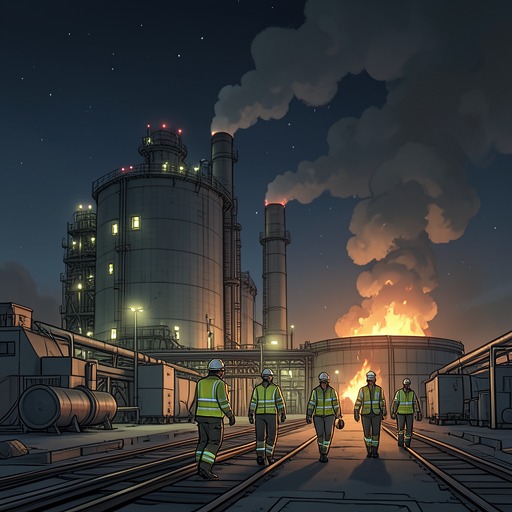
At 1:23:58 on April 26, 1986, a series of explosions destroyed the reactor housed in Energy Block #4. The historical account identifies the event as the defining technological catastrophe of the century; the figures that follow show how quickly a single reactor disaster became a national crisis for Belarus. During the Second World War, the Nazis had destroyed 619 Belarusian villages along with their inhabitants. As a result of Chernobyl, Belarus lost 485 villages and settlements, 70 of them buried permanently underground. The comparison places a technological disaster beside the country’s wartime devastation without making the two identical: in each case, whole communities and inhabited places were lost.
The disaster’s reach is also measured in people rather than only in land. One in five Belarusians lived on contaminated ground, a population of 2.1 million that included 700,000 children. Radiation was identified as the leading demographic factor in the depopulation of Belarus. In Gomel and Mogilev regions, the areas most affected by the disaster, deaths exceeded births by 20 percent. These figures give the station’s destruction a slow aftermath: contamination remained in forests, marshes, and agricultural land, while the reported numbers of people with cancer, mental retardation, neurological disorders, and genetic mutations rose year by year amid the continuing presence of low doses of radiation.
Fire at the Reactor
The testimony of a young wife establishes the human scale of the station’s emergency response. She and her husband lived in the dormitory of the fire station where he worked: their room was on the second floor, above the trucks, and three other young couples shared their kitchen. When a noise woke her, she looked out of the window and saw him. He told her there was a fire at the reactor, asked her to close the window and go back to sleep, and said he would return soon. She did not see the explosion itself; she saw flames, smoke, and a radiant sky, then waited as the hours passed.
Her later account describes what the firefighters encountered. Smoke came from burning bitumen covering the roof, which her husband said was like walking on tar. Firefighters tried to beat down the flames and kicked at burning graphite with their feet. They had gone in their shirt sleeves, without their canvas gear, and had not been told what the fire involved: they had been called to a fire, and that was all. The contrast between the ordinary call-out and the reactor’s burning graphite reveals the limits of the response as the testimony presents it. The workers arrived as firefighters, but were not equipped or informed for the danger at the station.
The interrupted domestic plan sharpens that account. At six that morning, the couple were supposed to visit his parents in Sperizhye, forty kilometers from Pripyat, to plant potatoes. He loved sowing and plowing; his parents had built him a new house and had not wanted him to move to the city. After military service in the fire brigade in Moscow, he had wanted to be a fireman and nothing else. The planned trip gives way to the fire at the station, while the wife’s narration returns to the voice she remembers and the call that never comes. Her testimony records not only the emergency but the disappearance of an ordinary future.
The Cover and the Unresolved Reactor
The destroyed fourth reactor was later known as the Cover. It still held about twenty tons of nuclear fuel in its lead-and-metal core, while what was happening inside remained unknown. The structure enclosing it, also described as a sarcophagus, was praised as well made and uniquely constructed, yet the conditions of its assembly left weaknesses. Built in absentia, it had plates joined with the aid of robots and helicopters; fissures resulted, and some estimates put the area of spaces and cracks at more than 200 square meters. Radioactive particles continued to escape through them.
The question of structural failure could not be answered with certainty. Many connections and constructions could not be reached to determine whether they were sturdy, so the possibility of the Cover’s collapse remained beyond direct inspection. The account nevertheless states the stakes plainly: if it collapsed, the consequences would be even more dire than those of 1986. The station’s decisive historical event thus remains physically unfinished. The reactor was destroyed, but its core, enclosure, and inaccessible joints persist as material hazards whose condition cannot be fully known.